





The Costly Townhome Insurance Mistake That Could Leave You Without a Roof
A townhome gives you a bit of both worlds. You get the space and privacy of a house, and an HOA handles the landscaping and neighborhood upkeep.
Because townhomes share walls and belong to an association, it is easy to assume they are insured just like condominiums. If you make that assumption, or your agent makes it for you, a large part of the building can end up uninsured.
You'll see both ownership setups across North Metro Atlanta, whether you are looking in Marietta, Roswell, Alpharetta, Johns Creek, Sandy Springs, or Woodstock. Know which one you are buying before you bind a policy.
Not All Townhomes Are Owned the Same Way
Two townhome communities can look identical from the street. Legally, they are usually set up in one of two ways, and what separates them is how title is written and what the recorded documents say about who insures the building.
Condo-style townhomes
A property is a condominium in Georgia only when a declaration, plus the required plats and plans, is recorded under the Georgia Condominium Act (O.C.G.A. § 44-3-70 et seq.). You own a unit as that declaration defines it, and you share ownership of common elements with the other unit owners.
People often call this owning "from the drywall in." The declaration sets the exact boundaries, not the way the building looks from the street.
Your HOA dues typically help pay for a master insurance policy. Georgia law requires that association policy to cover the buildings at full insurable replacement cost, including foundations, roofs, exterior walls, windows, and doors. It also has to cover certain original interior items, such as sheetrock, the HVAC system, and original-quality floors, cabinetry, and built-in appliances, regardless of who is responsible for maintaining them.
Improvements you make later may still fall to your own policy. The unit owner's policy is usually written on an HO-6 form, and it is meant to cover personal belongings, liability, and the parts of the unit the master policy does not insure.
Fee-simple townhomes
Many townhomes are not condominiums at all. You may hold fee-simple title to a lot, including the land under the home and the entire physical building: the roof, exterior walls, and foundation. You can still share walls and pay HOA dues.
Communities like this are often governed by recorded covenants. If the declaration affirmatively elects into it, the Georgia Property Owners' Association Act (O.C.G.A. § 44-3-220 et seq.) can also apply. That Act creates a framework for mandatory-membership associations.
The Condominium Act specifically requires the association to insure the buildings. In a fee-simple community, what the HOA insures is typically set out in the declaration and CC&Rs.
In a typical fee-simple setup, the HOA's insurance is written for common areas like a pool, clubhouse, or entrance features. That is common, but it is not automatic, and some planned communities carry a master policy that also covers the residential structures.
Fannie Mae's selling guide accounts for both arrangements in a planned unit development. The owner usually needs an individual policy on the home, unless the legal documents provide a master policy that covers both the common elements and the residential structures.
Some communities are hybrids. The recorded declaration and CC&Rs control who is responsible for insuring what. Don't guess based on the word "townhome."
That is just as true in Marietta as it is in Roswell, Alpharetta, or Johns Creek.
The Danger of the "Cheaper" Quote
When you shop for townhome insurance, one quote may come back a lot cheaper than the others. Before you treat that as a win, look at what is actually being quoted. Sometimes an agent sees the word "townhome" and quotes a "walls-in" condo policy instead of a full homeowners policy.
A standard homeowners policy, most often an HO-3 or Special Form, is designed to insure the dwelling structure itself. The National Association of Insurance Commissioners says this is the most popular homeowners form, and it covers the property against all perils except those the policy specifically excludes.
A condo policy is usually written on an HO-6, or Condominium Unit Owners Form. The NAIC describes it as coverage for your personal property and for your walls, floors, and ceiling. In its homeowners report, the NAIC also notes that tenant and condominium policies do not include coverage for the residential structure beyond the unit owner's insurable interest.
The Insurance Information Institute makes a similar point. A condo owner's individual policy is meant to cover belongings, liability, and the interior structural elements the master policy does not.
An HO-6 is not priced to rebuild the whole building, so it can look like a bargain next to a full homeowners quote. If you put a walls-in condo policy on a fee-simple townhome whose HOA does not insure the structure, you may have created a large gap. The roof, siding, and exterior walls may have little or no coverage under either policy.
When a townhome quote comes in far cheaper than the others, I don't celebrate. I slow down and read the form.
What Happens When Disaster Strikes?
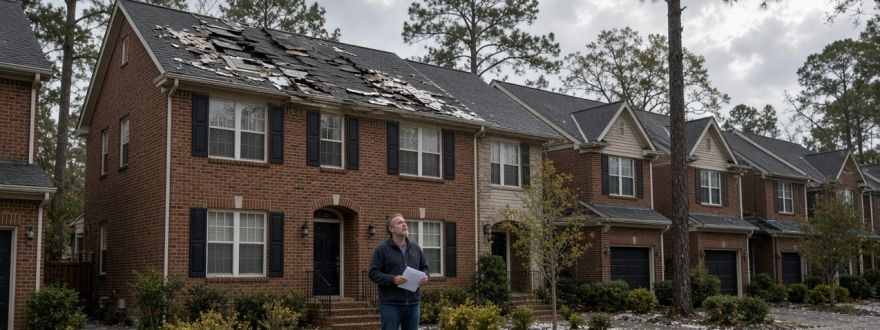
Say a severe hailstorm tears up the roof of your townhome in Marietta or Woodstock, a tree comes through your siding, or a fire damages the exterior. You file a claim under a walls-in condo policy.
That kind of policy is generally not designed to rebuild the roof, exterior walls, or foundation. Coverage still depends on the actual policy wording and any building-items limit, but an HO-6 is written for a unit owner's interest, not for the full structure of a fee-simple home.
So you turn to the HOA. If the home is fee-simple and the governing documents only require the association to insure common areas, the HOA may tell you the exterior is your property and your responsibility.
You can end up stuck in the middle, with no policy clearly on the hook for the roof or walls. Repairing or rebuilding that structure can be an expensive out-of-pocket cost, in some cases into the tens of thousands of dollars, and more if a fire or other serious loss takes down a large part of the building. You would still be expected to keep paying the mortgage while you sort it out.
Then there is the lender. Mortgage contracts typically require you to keep adequate hazard insurance on the property. If a lender or servicer has a reasonable basis to believe your policy does not meet that requirement, federal servicing rules allow it to purchase force-placed insurance and charge you for it (12 CFR 1024.37).
The CFPB notes that this coverage is usually more expensive than a policy you buy yourself, and in many instances protects only the lender, not you. The servicer generally has to warn you at least 45 days before it charges you.
How to Protect Yourself Before You Close
Before you sign off on a policy for your townhome, take three simple steps:
- Confirm your ownership type. Ask your real estate agent or closing attorney whether the property is fee-simple or legally structured as a condominium. In Georgia, a condominium exists only if the declaration has been recorded.
- Check the HOA documents. Review the association's declaration and CC&Rs to see whether the HOA insures the exterior roofs and walls, only the common areas, or some mix of the two. The documents control, including in hybrid communities.
- Ask your agent one direct question: "Does this quote cover the entire building structure from the roof down, or is it a walls-in condo policy?"
A Marietta agent who works with townhome communities across North Metro Atlanta can review the property details and the HOA documents with you. That can help you confirm you are being quoted the right kind of policy before you close.
Want a second look at your townhome coverage?
The time to find out you have a walls-in policy on a fee-simple townhome is before a storm, not after. If you'd like me to look over a quote or a current policy, I'll tell you what I see. If the form already matches the way the property is owned, I'll tell you that too.
I can't promise a lower price or a particular claim result. I can compare several carriers side by side and help you understand what the quote actually covers.
We're an independent agency based in Marietta, and we help homeowners across Roswell, Alpharetta, Johns Creek, Sandy Springs, and Woodstock. Call me at 404-850-7501 or reach out through www.flex-ins.com.
If you are a realtor or loan officer helping a buyer close on a townhome in this area, send over the declaration and the insurance quote before closing. We can check whether the form matches the way the property is owned.
Frequently asked questions
How do I tell if my townhome is fee-simple or a condominium?
Don't go by the word "townhome" or by how the buildings look. Ask your closing attorney or realtor, and check whether a condominium declaration has been recorded under the Georgia Condominium Act. If you hold title to the lot and the building, it is generally fee-simple, even if there is an HOA.
Does my HOA's insurance cover my townhome's roof?
Only if the recorded documents and the master policy say so. In a Georgia condominium, the association's policy is required to cover roofs and exterior walls.
In many fee-simple townhome communities, the HOA insures only common areas, though some planned developments do carry master coverage on the homes themselves. Read the declaration and CC&Rs.
What is the difference between an HO-3 and an HO-6 policy?
An HO-3, the common Special Form homeowners policy, is designed to insure the dwelling structure. An HO-6 is a condominium unit owners policy. It generally covers your personal property and certain interior building items, and it assumes a master policy is handling most of the building.
Can my lender force-place insurance if I have the wrong type of policy?
Possibly. A servicer may purchase force-placed insurance if it has a reasonable basis to believe you have not kept the hazard insurance your mortgage requires, including when coverage appears insufficient.
That insurance is usually more expensive and often protects the lender more than you. You generally get at least 45 days' notice before you are charged, and you can send proof of a policy that meets the loan requirements to have it canceled.
This is general information, not legal or coverage advice. Individual policies, carriers, HOA documents, and situations vary.
Sources
- Official Code of Georgia, § 44-3-70, Georgia Condominium Act (via Georgia Commons)
- Official Code of Georgia, § 44-3-72, Creation of condominium
- Official Code of Georgia, § 44-3-107, Insurance coverage
- Official Code of Georgia, § 44-3-220, Georgia Property Owners' Association Act
- Official Code of Georgia, § 44-3-221, Definitions
- Official Code of Georgia, § 44-3-222, Creation of property owners' development
- NAIC, A Consumer's Guide to Home Insurance
- NAIC, Dwelling Fire, Homeowners Owner-Occupied, and Homeowners Tenant and Condominium/Cooperative Unit Owner's Insurance Report: Data for 2023
- Insurance Information Institute, Insuring a co-op or condo
- Insurance Information Institute, What is homeowners insurance?
- Fannie Mae Selling Guide, B7-3-03, Master Property Insurance Requirements for Project Developments
- Fannie Mae Selling Guide, B7-3-04, Property Insurance Requirements for Individual Units in a Project Development
- CFPB, 12 CFR 1024.37, Force-placed insurance (Regulation X)
- CFPB, What can I do if my mortgage lender or servicer is charging me for force-placed homeowner's insurance?
- CFPB, Your mortgage servicer must comply with federal rules